
Finding a good Ayurvedic medicine manufacturer in India can be crucial for companies looking to start, expand, or enhance their Ayurvedic range of products. A lot of factors that contribute to the overall success of a product may depend on the manufacturer selected.
Ayurveda has a long history in India, whereas modern firms need to have an organized manufacturing process along with consistency in quality and production. It is an excellent chance for companies that would like to marry the two.
Table of Contents
- Why Choosing the Right Ayurvedic Manufacturer Matters
- What Does an Ayurvedic Medicine Manufacturer Do?
- 7 Important Factors to Consider
- Quality and Manufacturing Standards
- Ayurvedic Product Forms and Manufacturing Capabilities
- Third-Party Ayurvedic Manufacturing
- Packaging and Private-Label Solutions
- How to Choose the Right Manufacturing Partner
- Why India Is an Important Ayurvedic Manufacturing Hub
- Grecian’s Ayurvedic Manufacturing Capabilities
- Frequently Asked Questions
- Final Thoughts
Why It’s Important to Select a Suitable Ayurvedic Manufacturer
When you purchase an Ayurvedic product, you are not simply buying a packaged product ready for consumption. There are a number of processes that go into developing and manufacturing an Ayurvedic product.
Consequently, it is vital to have the right manufacturer that can support your commercial requirements.
For a business, the right Ayurvedic medicine manufacturer in India can provide access to established manufacturing infrastructure without requiring the company to build its own facility from the beginning.
This can allow businesses to concentrate on areas such as branding, sales, distribution, marketing, customer relationships, and product expansion.
At the same time, businesses should carefully evaluate whether the manufacturer’s facilities and processes are suitable for the specific Ayurvedic product they intend to manufacture.
What Does an Ayurvedic Medicine Manufacturer Do?
An Ayurvedic medicine manufacturer produces Ayurvedic formulations according to defined specifications and applicable regulatory requirements.
Depending on the manufacturer’s capabilities, services can include:
- Ayurvedic formulation development
- Raw-material sourcing
- Manufacturing and processing
- Quality control
- Product testing
- Packaging
- Private-label manufacturing
- Third-party manufacturing
- Bulk production
- Customized product solutions
The exact manufacturing process depends on the formulation and dosage form.
Ayurvedic products can be manufactured in different forms, including oral medicines, powders, oils, juices, tonics, creams, ointments, tablets, and other formulations depending on the manufacturer’s infrastructure and applicable approvals.
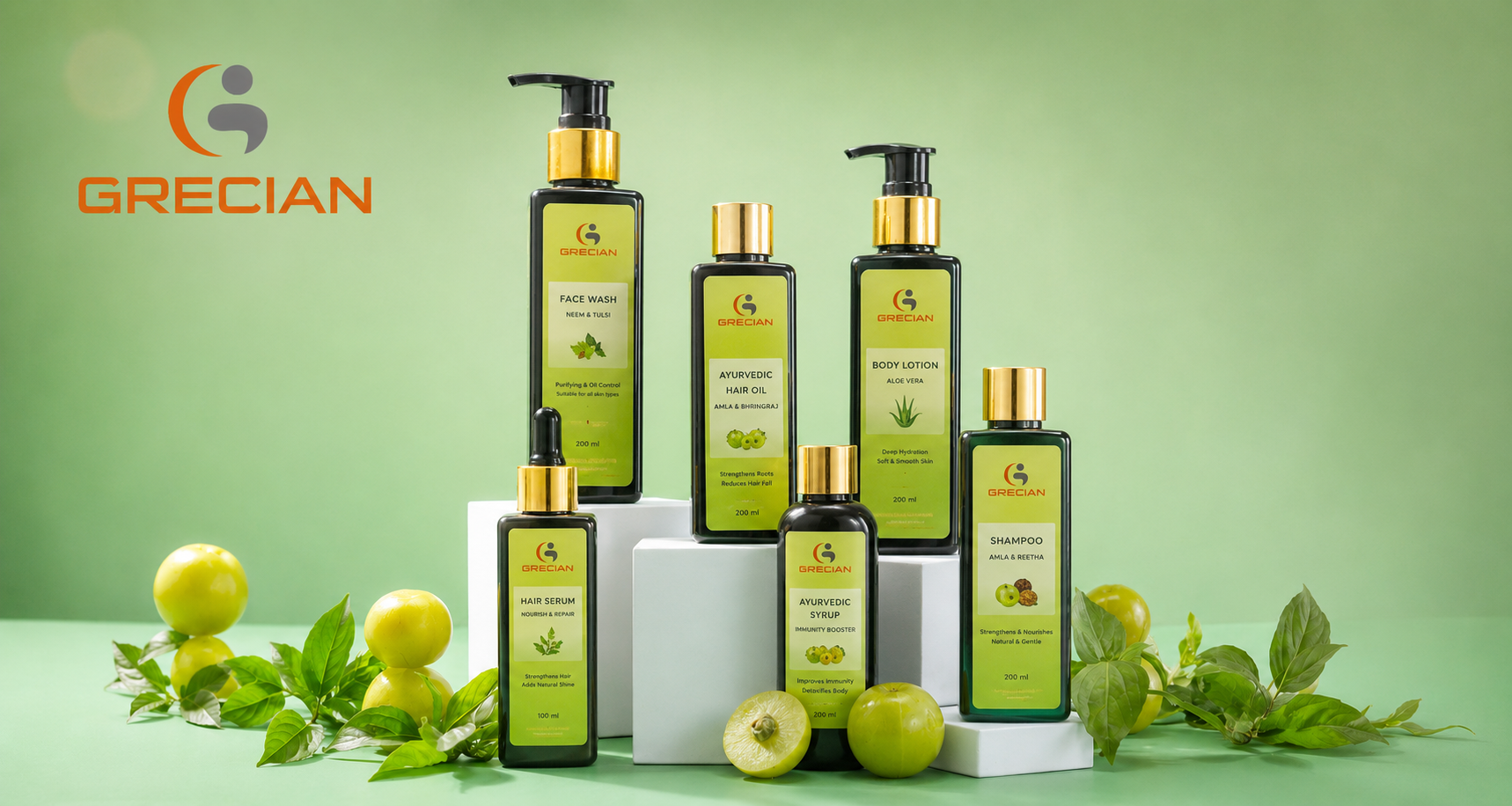
Grecian states that it manufactures Ayurveda and herbal supplements, medicines, and cosmetics and can produce Ayurvedic products in forms including ointments, oral medication, creams, herbal medicines, powders, pills, juices, tonics, and oils.
7 Important Factors to Consider When Choosing an Ayurvedic Medicine Manufacturer in India
1. Manufacturing Infrastructure
The first factor to evaluate is the manufacturer’s production infrastructure.
A suitable Ayurvedic medicine manufacturer in India should have facilities and equipment appropriate for the products you plan to manufacture.
Production spaces, machinery, quality control rooms, storage systems, packaging facilities, and manufacturing atmosphere should be taken into account by businesses.
Modern machines may provide process uniformity, and skilled people may assist in managing production processes in accordance with established procedures.
Companies should not go for manufacturers simply due to their low quotations. Their infrastructures should be considered according to product demands.
2. Quality Control and Testing
Quality should be one of the most important considerations when selecting an Ayurvedic manufacturing partner.
Raw materials, formulation, production processes, finished products, and packaging may require appropriate checks depending on the product and applicable requirements.
According to the Ayurveda Ministry, Ayurvedic drugs have to conform to certain requirements related to licensing and Good Manufacturing Practice, with respect to quality standards.
Quality systems form a necessary component of Ayurvedic production.
It is recommended that organizations enquire from prospective manufacturers about their controls on raw materials, tests conducted, documentation, quality control procedures, and the release process of finished products.
3. Raw-Material Sourcing
The quality of an Ayurvedic formulation is closely connected to the quality and suitability of its ingredients.
A manufacturer should have a structured approach to sourcing and evaluating raw materials according to the requirements of the formulation.
Businesses should discuss:
- Source of raw materials
- Quality specifications
- Supplier evaluation
- Storage conditions
- Testing requirements
- Documentation
- Traceability
Grecian states that it maintains long-term relationships with trusted vendors for procuring raw materials and describes its Ayurvedic manufacturing process as focused on quality, safety, and efficacy.
Clear raw-material sourcing practices can help establish greater consistency across production batches.
4. Product Development and Formulation Support
Companies might have a product idea, but they may lack the manufacturing capabilities to turn that idea into a marketable product.
It is here that formulation and development services can be useful
A capable Ayurvedic medicine manufacturer in India may help businesses understand suitable product formats, manufacturing requirements, packaging considerations, and production feasibility.
As per Grecian, the formulation team working in Ayurveda consists of experts from disciplines like biology, engineering, management, and research, and carries out research based on technology.
The firms should have detailed discussions about their product requirements before preparing any formulation.
5. Production Capacity and Scalability
A business may start with one Ayurvedic product but later expand into multiple formulations.
Therefore, production capacity and scalability should be considered from the beginning.
Ask the manufacturer about:
- Minimum order quantities
- Batch sizes
- Production capacity
- Lead times
- Packaging capacity
- Future expansion
- Repeat-order management
Partnering with a manufacturer who is capable of adapting to growing demands will help the company increase its portfolio without looking for another vendor.
According to Grecian, it offers customized solutions and strives to provide timely delivery in any situation.
6. Packaging and Private-Label Capabilities
Packaging plays a vital role in commercialization of any Ayurvedic product.
Depending upon the products, packaging may include bottles, packing containers, tube packaging, boxes, sachets, or labelling.
In case of private labels, the packaging should be consistent for brands too.
A professional Ayurvedic medicine manufacturer in India may offer customized packaging and private-label solutions according to the product requirements.
Before production, businesses should clarify:
- Packaging format
- Pack size
- Label requirements
- Artwork
- Branding
- Product information
- Batch information
- Storage instructions
- Regulatory requirements
Grecian describes its Ayurvedic manufacturing services as including packaging in suitable bags or containers and states that it offers tailored solutions aligned with brand goals.
7. Third-Party Manufacturing Support
Third-party manufacturing can be an effective option for businesses that want to launch Ayurvedic products without establishing their own manufacturing facility.
According to this model, the manufacturing partner performs the production tasks mutually agreed upon, whereas the client concentrates on branding, marketing, distribution, sales, and business development.
A third party Ayurvedic manufacturing assignment may include:
- Product requirement discussion
- Formulation review
- Manufacturing feasibility
- Packaging selection
- Commercial discussion
- Production planning
- Manufacturing
- Quality testing
- Packaging
- Dispatch The process varies based on the product, manufacturer, regulations, and the consensus reached by both parties involved.According to Grecian, it offers contract manufacturing services for Ayurveda and herbal products, drugs, and cosmetics.
Quality and Manufacturing Standards
Quality and regulatory compliance are essential when dealing with Ayurvedic medicines.
Businesses should understand that Ayurvedic medicines are subject to applicable regulatory requirements in India.
Ayush Ministry describes Ayurvedic medicine manufacturer in India that the enforcement of quality control and licensing of manufacture of medicines under Ayurveda, Siddha, Unani, and Homoeopathy systems shall be carried out by respective State Drug Controller or State Licensing Authority, respectively. Good Manufacturing Practice and pharmacopeial quality standards come under this regulation framework.
Businesses can refer to the official Ministry of Ayush resources for current information regarding Ayurveda and applicable regulatory frameworks.
According to Grecian, the manufacturing plant is fitted with modern equipment and quality control systems and adheres to the GMP guidelines outlined in Revised Schedule M. The quality management team of the company keeps tabs on the processes of sourcing raw materials, production, testing, packaging, and final testing of the products.
The companies must always check out the licenses and other regulations required for manufacturing particular products.
Ayurvedic Product Forms and Manufacturing Capabilities
One advantage of working with an experienced manufacturer is the ability to develop a broader product portfolio.
Depending on manufacturing capabilities, Ayurvedic products may be developed in different forms.
Oral Ayurvedic Products
Oral products can include tablets, pills, powders, juices, and tonics, depending on the formulation and applicable requirements.
Herbal Products
Herbal products could also comprise those which contain botanicals as ingredients, and these could be produced in various dosage forms based on their categorization and usage.
Grecian states that its Ayurvedic manufacturing capabilities include ointments, oral medication, creams, herbal medicines, powders, pills, juices, tonics, and oils.
Businesses should select the dosage form based on product requirements, intended use, formulation, target market, and applicable regulatory framework.
Third-Party Ayurvedic Manufacturing
Third-party manufacturing provides businesses with access to established production infrastructure while allowing them to focus on commercial activities.
It can be useful for:
- Ayurvedic brands
- Pharmaceutical companies
- Healthcare businesses
- Distributors
- Wellness businesses
- Entrepreneurs
- Private-label brands
- Companies expanding their product portfolio
A major benefit is that the business does not necessarily need to invest in an independent manufacturing facility.
Instead, it can work with an established Ayurvedic medicine manufacturer in India that already has relevant production infrastructure and technical resources.
Yet, companies need to precisely define their roles before undertaking the third-party manufacturing process.
The deal should specify such aspects as product specifications, volumes, packaging, testing, documentation, deadlines, payments, and intellectual property rights, among others.
Packaging and Private-Label Ayurvedic Products
Private-label manufacturing allows businesses to sell products under their own brand while production is handled by a manufacturing partner.
This model can help businesses enter the Ayurvedic market without developing an entire manufacturing facility from scratch.
Packaging can also play a major role in product positioning.
The design of a professional pack must effectively convey the identity of the brand but at the same time provide all necessary product information, including protection of the product from damage while in storage and transportation.
Firms should collaborate with the producer and regulatory authorities for proper labelling, claims, ingredients, directions, warnings, and other information in relation to the product and the market.
Frequently Asked Questions
What should I look for in an Ayurvedic medicine manufacturer in India?
Search for manufacturing infrastructure, experience, quality systems, raw materials control, product capability, packaging support, production capacity, regulatory preparedness, and communication.
Can Ayurvedic manufacturers provide third-party manufacturing?
Yes, some manufacturers provide third-party Ayurvedic manufacturing services. Businesses should confirm the manufacturer’s product capabilities, documentation, packaging options, MOQ, production timelines, and applicable regulatory responsibilities.
What types of Ayurvedic products can be manufactured?
Depending on the manufacturer, Ayurvedic products can be produced in forms such as tablets, powders, pills, juices, tonics, oils, creams, ointments, and other formulations.
Is quality control important in Ayurvedic medicine manufacturing?
Yes. Quality control forms an integral component of the manufacture of Ayurvedic medicines under regulation. It is recommended that firms consider controls for the materials, manufacturing, testing, documentation, and quality of finished products.
Can Ayurvedic manufacturers provide private-label products?
Some companies offer private labelling, where firms can sell products under their own name. Matters of packaging, formulation, documentation, and regulation must be sorted out prior to manufacturing.
What is third-party Ayurvedic manufacturing?
The third-party manufacture of Ayurvedic products is a business model where an existing manufacturer manufactures goods agreed upon by both parties, whereas the client takes care of activities like branding, marketing, sales, and distribution.
Final Thoughts
Choosing the right Ayurvedic medicine manufacturer in India requires careful consideration of more than production pricing.
A company should consider issues such as manufacturing infrastructure, quality management, source of materials, formulating capabilities, packaging, manufacturing capacity, third-party manufacturing capabilities, and regulatory compliance when making this choice.
Third-party manufacturing will help companies create a well-organized product portfolio without having to set up manufacturing infrastructure of their own.
Third-party and private label manufacturing will also offer the flexibility of entering or expanding in the market of Ayurvedic products.
Grecian offers manufacturing facilities that can cater to any company searching for an Ayurvedic and herb manufacturing solution and also private label options. The dedicated manufacturing page by Grecian on Ayurvedic products also offers detailed information on its offerings.
The right partnership should be built around quality, consistency, transparent communication, appropriate regulatory compliance, and long-term business support.